I received this in an e-mail several weeks ago and thought it tied in nicely with the article on Consumption. Americans and some Europeans seem to spend alot of money on food, mainly junk food. Mexicans eat healthy but look at all the Coke in the background. Look at the folks in Chad. Can't even imagine! Perhaps we need a lot more awareness of how we are spending our money (and what we are putting into our bodies)!
http://www.everybodygoto.com/2007/10/12/what-people-eat-around-the-world/
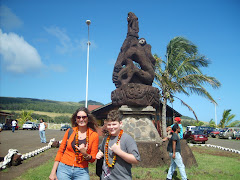
Rapa Nui
Vacation of a Lifetime
Monday, February 25, 2008

Wednesday, February 20, 2008
Webb's article hits close to my heart as I have always been interested in Geology, landscapes and the earth. As my interests grew to include the cultural aspects of the land and how people adapted to their environment: what they did to survive, how they survived and the big question, Why there?, thus peaked my interest in Geography. Webb states it best with, "To me land is the matrix out of which the culture grows." It is the framework, "firm under your feet." I studied history in high school and ashamed to say, barely passed with a"D." Yet once I began traveling, and actually saw the land on which the battles were fought, or saw the documents that changed the nation, then it became real for me and then did I begin my quest for more information and history. Webb points out that each man had to fend for themselves and experience what would work best for him, without knowing the outcome. The land on which they decided to settle was some of the most difficult as far as weather, terrain and aridity, yet they perservered and their determination changed the way we look at the whole frontier. No longer is it a desolate place of little or no population, a territory crossed only in passing by the early trappers, hunters and pioneers attempting to work their way west or to someplace else, but man's resourcefulness led him to settle in this area and learn to work the land and its surroundings into a place of permanance, a home.
Popper, Lang and Popper's (P,L and P)article on the census was interesting, although I am not too fond of the way Geographers have a tendency to criticize other's works, in how the census was taken during the 19th century. Recently I have been interviewed by the census takers in my area and when I read that they originally asked as many as 13,000 questions, was a bit relieved. If you have ever been one of the questionees of a census, they come over to your home 4 times, once a month for 4 months. Then, they interview you by phone once a month for the remaining year. At times it seems a bit offensive and the questions somewhat inappropriate, but according to P, L and P's article, they even asked questions "ranging from garbage disposal to polygamy." (I hope to find some of this information useful in my research on Colorado City, AZ).
As much as I was annoyed , the job of a census taker in those days had to be somewhat boring, tedious and at times dangerous. They had to traverse an immense portion of land, most likely on horseback or wagon, and had to endure who knows what kind of weather or hardships along the way, all in the government's quest for information regarding density of places and regions.
Popper, Lang and Popper's (P,L and P)article on the census was interesting, although I am not too fond of the way Geographers have a tendency to criticize other's works, in how the census was taken during the 19th century. Recently I have been interviewed by the census takers in my area and when I read that they originally asked as many as 13,000 questions, was a bit relieved. If you have ever been one of the questionees of a census, they come over to your home 4 times, once a month for 4 months. Then, they interview you by phone once a month for the remaining year. At times it seems a bit offensive and the questions somewhat inappropriate, but according to P, L and P's article, they even asked questions "ranging from garbage disposal to polygamy." (I hope to find some of this information useful in my research on Colorado City, AZ).
As much as I was annoyed , the job of a census taker in those days had to be somewhat boring, tedious and at times dangerous. They had to traverse an immense portion of land, most likely on horseback or wagon, and had to endure who knows what kind of weather or hardships along the way, all in the government's quest for information regarding density of places and regions.
Tuesday, February 12, 2008
Of all the geographers' works we have read, I tend to favor these of Pierce Lewis. His concept of going out there and "looking" at what is around you and the article "Learning from Looking..." really captured my interest. Geography can be taught from books and articles but in order to really appreciate the total landscape and people/places, one must venture out of his comfort zone and experience the entire area. It is clear why he has been rated as one of the top geographers in Jeffrey Smith's writing.
In his article, "Learning from Looking," Lewis mentions that what we do to a certain place has a lot to do with what we think of that particular place. Many people think of Nevada as a pit; in fact, much of our nuclear waste has been deposited in Nevada through the years. I used to think the same way; it was boring and nothing but sand and desolation in every direction. However, once I began studying geology, I began seeing Nevada through different eyes. It has its own beauty and the deeper I dug, the more beauty I found.
Lewis' review on Bellefonte, PA was a carefully written history of a small town that had its birth in better, more promising times and is now faced with a slow and painful illness. He states that, "Small towns may be sick, but they ar far from dead." I tend to agree with Lewis in that I have always preferred to live in a small town. Growing up in the suburbs of St. Louis, MO, I rarely ventured into the city, yet preferred to head to the river and the woods on horseback to enjoy nature. Since my graduation from High School, I have never lived in a town with more than 30,000 population. In the article, a poll was conducted which showed that most people preferred to live in small towns over big cities; the community relations in a small town were more favorable in contrast to the cost of living in a big city being the incidence of high crime. Yet, in his article Lewis tends to see that the overall mood or common feeling among those inhabitants of Bellefonte as one of "lost hope" in their community. This is the part that is sad to me; the hopelessnes and despair that these people feel towards their home, the place where they live. This place that once offered so much promise and hope, has turned into somewhat of a dying ghost town on the verge of extinction.
Which brings up another point for me. I am almost finished reading Route 66: Iconography...
I can't help but feel a great sense of loss due to the fact that Route 66 was right outside my door while I was growing up. Many weekends were spent on the road with my dad, traveling to various places along the original highway that I have been reading about. I have fond memories of stopping at "mom and pop" cafes along the road, putting quarters into the private jukebox on our table and singing along to tunes which included, you guessed it, "Get your kicks on Route 66." These quaint one of a kind restaurants have sadly been replaced by the "clone" restaurants like Cracker Barrel, Chiles, Applebys, and McDonalds. It's a rare occasion to find the traditional roadside cafes that used to dominate the Route 66 landscape. This past summer my daughter and I took a road trip to the Grand Canyon and decided to venture out of the way a bit and traverse the last remnant of Rte. 66 east of Flagstaff. I don't know what I expected, but the first place at which we stopped was a store which carried all kinds of memorabilia from Rte. 66. Not antiques, but reproductions of things one might have seen along the way (such as those which were a comfort for me as a child). It definitely wasn't the same for me and left me with a bit of anxiety and depression and the feeling that I couldn't get off that stretch of highway fast enough; perhaps like the remaining inhabitants of Bellefonte, PA.
Although one can't change the inevitable; change itself is inevitable. We can only appreciate all that is around us right now, treasure it and learn that it is not going to be forever. But it holds forever a place in our hearts and memories, that is something we can never lose nor can anyone take from us.
In his article, "Learning from Looking," Lewis mentions that what we do to a certain place has a lot to do with what we think of that particular place. Many people think of Nevada as a pit; in fact, much of our nuclear waste has been deposited in Nevada through the years. I used to think the same way; it was boring and nothing but sand and desolation in every direction. However, once I began studying geology, I began seeing Nevada through different eyes. It has its own beauty and the deeper I dug, the more beauty I found.
Lewis' review on Bellefonte, PA was a carefully written history of a small town that had its birth in better, more promising times and is now faced with a slow and painful illness. He states that, "Small towns may be sick, but they ar far from dead." I tend to agree with Lewis in that I have always preferred to live in a small town. Growing up in the suburbs of St. Louis, MO, I rarely ventured into the city, yet preferred to head to the river and the woods on horseback to enjoy nature. Since my graduation from High School, I have never lived in a town with more than 30,000 population. In the article, a poll was conducted which showed that most people preferred to live in small towns over big cities; the community relations in a small town were more favorable in contrast to the cost of living in a big city being the incidence of high crime. Yet, in his article Lewis tends to see that the overall mood or common feeling among those inhabitants of Bellefonte as one of "lost hope" in their community. This is the part that is sad to me; the hopelessnes and despair that these people feel towards their home, the place where they live. This place that once offered so much promise and hope, has turned into somewhat of a dying ghost town on the verge of extinction.
Which brings up another point for me. I am almost finished reading Route 66: Iconography...
I can't help but feel a great sense of loss due to the fact that Route 66 was right outside my door while I was growing up. Many weekends were spent on the road with my dad, traveling to various places along the original highway that I have been reading about. I have fond memories of stopping at "mom and pop" cafes along the road, putting quarters into the private jukebox on our table and singing along to tunes which included, you guessed it, "Get your kicks on Route 66." These quaint one of a kind restaurants have sadly been replaced by the "clone" restaurants like Cracker Barrel, Chiles, Applebys, and McDonalds. It's a rare occasion to find the traditional roadside cafes that used to dominate the Route 66 landscape. This past summer my daughter and I took a road trip to the Grand Canyon and decided to venture out of the way a bit and traverse the last remnant of Rte. 66 east of Flagstaff. I don't know what I expected, but the first place at which we stopped was a store which carried all kinds of memorabilia from Rte. 66. Not antiques, but reproductions of things one might have seen along the way (such as those which were a comfort for me as a child). It definitely wasn't the same for me and left me with a bit of anxiety and depression and the feeling that I couldn't get off that stretch of highway fast enough; perhaps like the remaining inhabitants of Bellefonte, PA.
Although one can't change the inevitable; change itself is inevitable. We can only appreciate all that is around us right now, treasure it and learn that it is not going to be forever. But it holds forever a place in our hearts and memories, that is something we can never lose nor can anyone take from us.
Thursday, February 7, 2008

Check out this site for a video on bio-fuel
http://www.ge.com/company/advertising/index.html?media_id=austria_400x300_10bit&c_id=aolaustria1a
http://www.ge.com/company/advertising/index.html?media_id=austria_400x300_10bit&c_id=aolaustria1a
Tuesday, February 5, 2008
It was interesting to read Wallach's articles, although a bit outdated. I did some further research and found that sheep ranching isn't even mentioned as a industry anymore. I wonder if emminent domain took over and it went back to the "highest and best use of the land." According to Wallach, "recreation and wildlife production" that would generate more income. The writing on Taft and its boming oil industry along with the Green River are both nicely written, short yet concise, articles on regions. In accordance with Hart's article on the Art of Geography, I feel that these were presented as an overview of the areas including a bit of History, Economy, Geology and in an art form. Geography seems to tie all these elements together. I especially liked this sentence, poetically structured, which paints a picture for me of what the town in Green River, Wyoming looks like as of this writing: "Many old square-logged cabins of that day still stand, weathered handsomely, misleadingly peaceful." (Wallach) If you have ever travelled through that area, the high plains, you will totally understand the region. It is nothing like peaceful in the dead of winter. My car broke down in Fort Bridger one year in November when the wind was howling at 95 mph and the wind chill was -20F. Had to hitchhike with my then 2 year old child to a gas station (fortunately there was one close). Yet to study and understand these regions, one must fully appreciate all that is involved with them from the moment of their discoveries, and that is where Geographers step in and use their art.
Tuesday, January 29, 2008
Appears that the common theme in our readings is "regions" or place, and humans reaction and interaction with their place. Yi-Fu Tuan's article points out that as early as the 18th century, Hun Lian-Chi gave thought to the effect population would have on the land. On the same note Williams article, "Deforesting the Earth" (2007) states that people have been exploiting forests for centuries for their basic needs and refers to it as, "an economic, not environmental issue." Tuan also mentions that most only look at the surface, that animals judge by "appearance" which is all they need to survive. However, our interaction with what is around us and our pursuit of individual happiness, has gone below the surface. As Tuan states, "Civilization has created beautiful surfaces, but at what cost?" Cultures through time have exploited the environment.
The concept of Bioregionalism brings about a new awareness of the earth and trying to get back to basics, starting with where one lives in realtion to a community and his place. Tied into Parson's article comes the idea of food as mentioned in Pollan's "Obsessed with Nutrition". We have come so far away from just eating to survive, eating what is available in or near the region that we live and consequently have an obsession with eating but not eating the right foods. Pollan says we need to "return to the local and the basic." Bioregionalism? I think so. Not only is it healthier for humans in the long run, it is also perhaps healthier for the environment.
Zelinsky spent years trying to figure out where the south began only to find out that the most distinguishable sign which was key in determining the southern boundary was the use of the mule over the horse for agriculture. Again, this is a regional trademark. He points out surface things which helped formulate his boundaries, type of construction, wells, architecture, town centers, etc., all examples of people using the regional resources at their disposal, but there was such a vide variety that one could not really characterize exactly where the south began due to these variations. Yet the one thing that pulled it all together was the use of one animal by a group or a culture of people.
Cultures have done things collectively for their survival that, in their judgment may have been right at the time, without consideration of long term effects on their ancestors.
Bottom line is we need to begin focusing on our own space or region on this planet and the impact our actions have on our place. We need to start thinking as a community and take care of our own "place" before we can reach out globally.
The concept of Bioregionalism brings about a new awareness of the earth and trying to get back to basics, starting with where one lives in realtion to a community and his place. Tied into Parson's article comes the idea of food as mentioned in Pollan's "Obsessed with Nutrition". We have come so far away from just eating to survive, eating what is available in or near the region that we live and consequently have an obsession with eating but not eating the right foods. Pollan says we need to "return to the local and the basic." Bioregionalism? I think so. Not only is it healthier for humans in the long run, it is also perhaps healthier for the environment.
Zelinsky spent years trying to figure out where the south began only to find out that the most distinguishable sign which was key in determining the southern boundary was the use of the mule over the horse for agriculture. Again, this is a regional trademark. He points out surface things which helped formulate his boundaries, type of construction, wells, architecture, town centers, etc., all examples of people using the regional resources at their disposal, but there was such a vide variety that one could not really characterize exactly where the south began due to these variations. Yet the one thing that pulled it all together was the use of one animal by a group or a culture of people.
Cultures have done things collectively for their survival that, in their judgment may have been right at the time, without consideration of long term effects on their ancestors.
Bottom line is we need to begin focusing on our own space or region on this planet and the impact our actions have on our place. We need to start thinking as a community and take care of our own "place" before we can reach out globally.
Monday, January 28, 2008
January 28
Geography Class Wow, I can't believe I now have a Blog! With all the reading we have to do am so glad I only have one class this semester. I am innundated with snow and the commute has been brutal, but I graduate in May and I will be DONE!! Hooray! Woke up to so much snow today so I just stayed in and read. Will post on my readings tomorrow.
Subscribe to:
Posts (Atom)
